Comparisons
StoryForge vs ChatGPT for writing a novel: why direct chat breaks at book length
A practical comparison of StoryForge and ChatGPT for authors who want to write a complete novel with AI without losing structure, voice, or continuity.
StoryForge vs ChatGPT for writing a novel: why direct chat breaks at book length
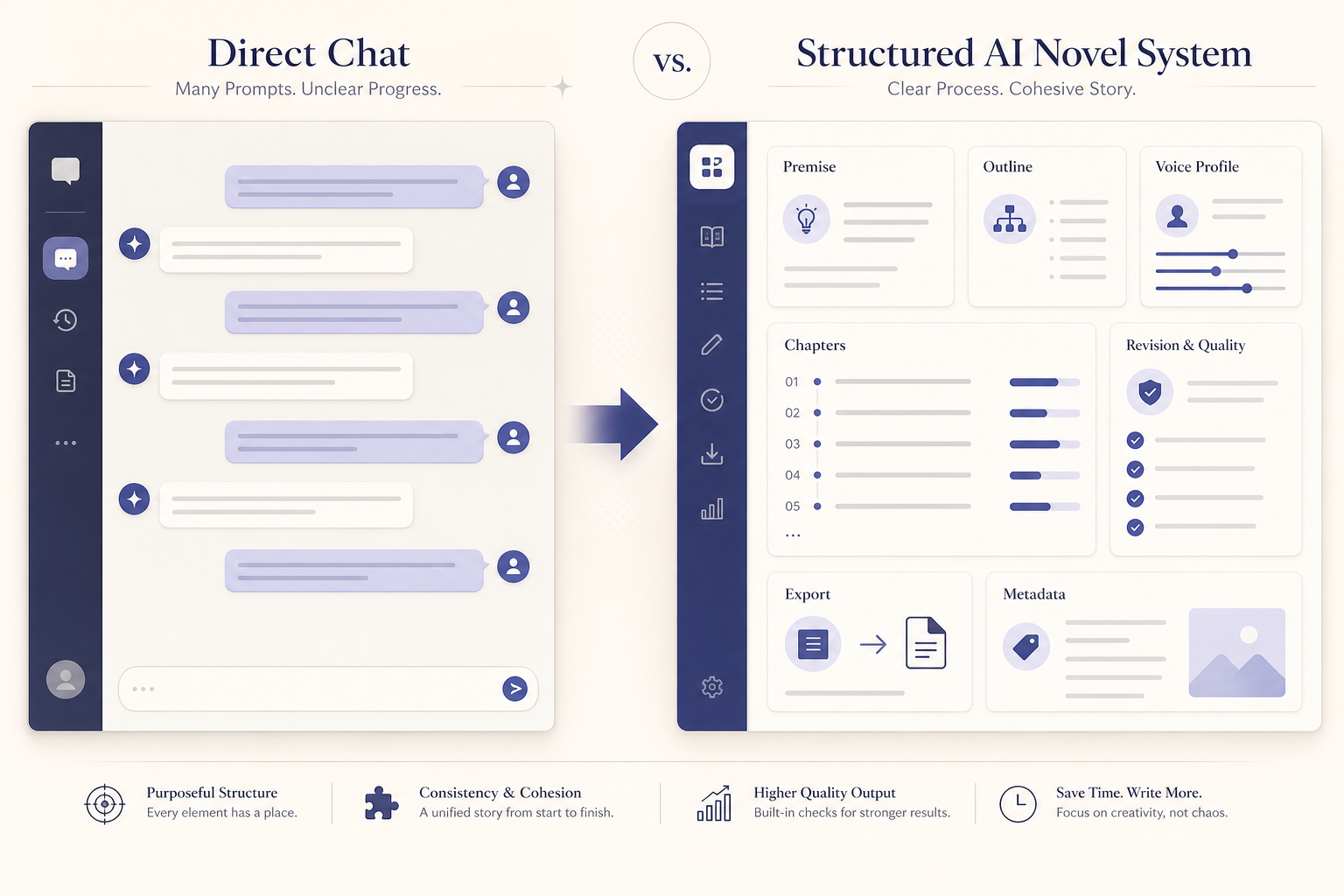
ChatGPT is useful for writing.
It can brainstorm plots, generate character ideas, rewrite paragraphs, summarize chapters, and help you think through a scene. For short work, it can feel almost unfair.
But writing a complete novel is not a short-work problem.
The question is not whether ChatGPT can produce prose. It can.
The question is whether a direct chat thread can carry a book from premise to publish-ready manuscript without you manually rebuilding the system around it.
That is where StoryForge and ChatGPT separate.
The short version
ChatGPT is a general AI assistant.
StoryForge is an AI-native novel production engine.
| Question | ChatGPT | StoryForge |
|---|---|---|
| Best fit | Flexible general writing help | Complete novel workflow |
| Structure | You create and maintain it | Built into the product |
| Memory | Chat and plan dependent | Organized around book state |
| Voice | Prompt dependent | Defined and checked through the workflow |
| Publishing | You assemble files and metadata | EPUB and metadata are part of the path |
ChatGPT can help you write pieces of a novel.
StoryForge is built to help you ship the novel.
Where ChatGPT is strong
ChatGPT is good when you know how to ask for what you want.
It can help with:
- premise brainstorming
- alternate titles
- character sketches
- outline variations
- scene ideas
- line edits
- chapter summaries
- market research
- ad copy and metadata drafts
That flexibility is why so many writers start there.
It is open-ended. You can ask anything. You can test five directions in five minutes.
For early exploration, that is useful.
The direct-chat problem
The same flexibility becomes the problem once the book gets long.
A novel is not one prompt. It is a persistent object.
It has:
- a premise
- genre expectations
- character arcs
- chapter beats
- world rules
- unresolved promises
- recurring voice patterns
- pacing commitments
- continuity constraints
- publishing metadata
In ChatGPT, the author has to keep that system alive.
You paste context. You summarize. You correct drift. You remind it what happened. You carry forward decisions from previous sessions. You create your own files. You keep track of which version is canonical.
That can work for a technical writer who likes operating the machine.
It is a mess for the author who wants to ship.
Better prompts do not solve the whole-book problem
Most writers respond to ChatGPT drift by writing better prompts.
That helps for a while.
Then the manuscript gets bigger.
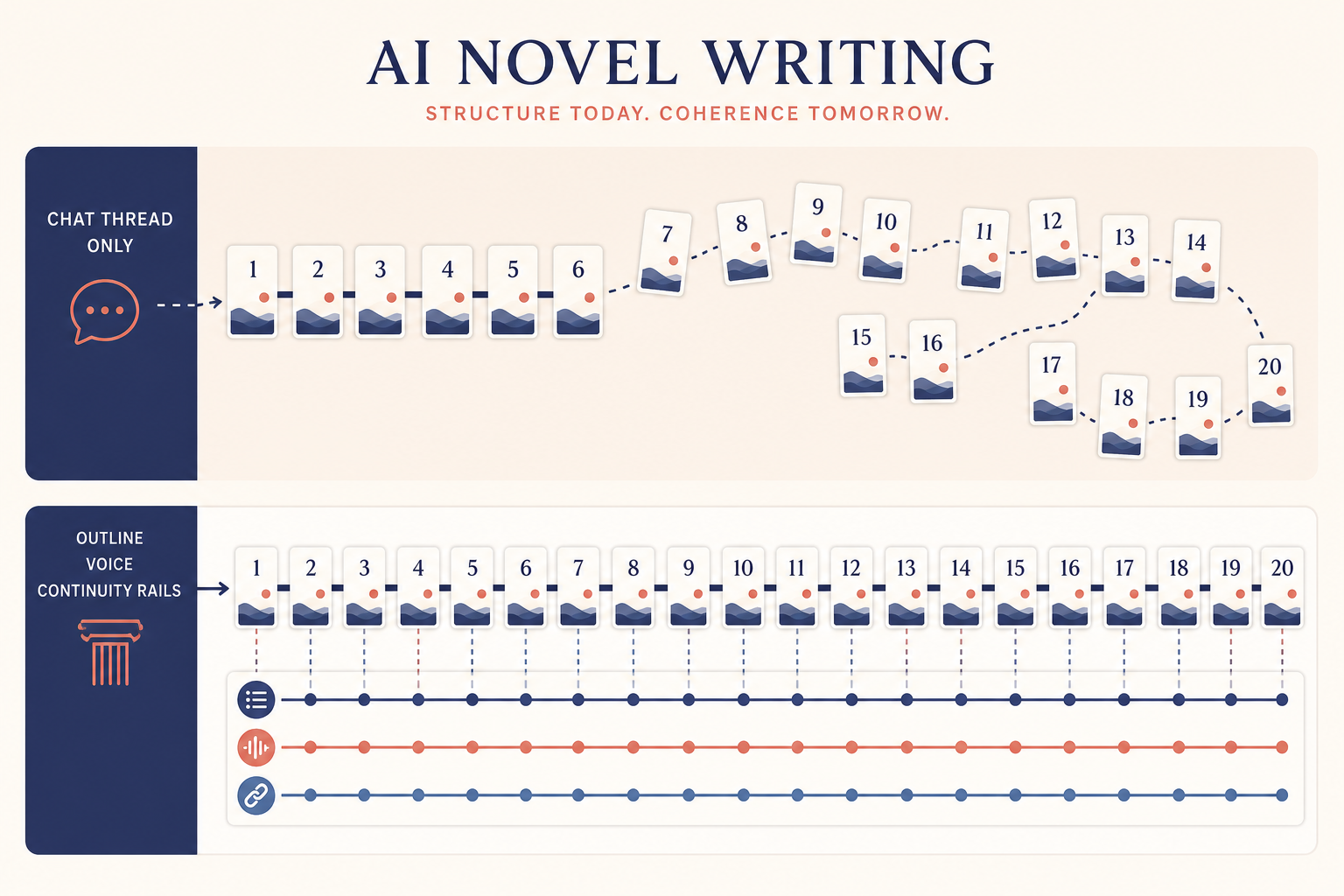
Chapter 1 sounds clean. Chapter 4 still works. Chapter 9 starts to soften. Chapter 14 has the same character using different rhythms, different instincts, and different emotional logic.
Now the problem is not the prompt.
The problem is that the book needs a workflow.
You need a place where outline, voice, chapter state, continuity, revision, and export all connect.
That is what StoryForge is.
What StoryForge does differently
StoryForge turns the book into a structured production process.
Instead of asking a blank chat box to hold the whole job, StoryForge walks the manuscript through stages:
- Define the premise.
- Shape the commercial direction.
- Build the outline.
- Lock the voice.
- Draft chapters from structured beats.
- Check continuity and voice.
- Revise with the book state intact.
- Export the manuscript.
- Generate publishing metadata.
The author still makes the calls that matter. StoryForge just stops forcing the author to rebuild the operating system every time they sit down.
That is the product difference.
ChatGPT is a brilliant general interface.
StoryForge is a book machine.
The privacy and control question
Some writers will still prefer ChatGPT because it is familiar and flexible. That is reasonable.
But if you are using ChatGPT directly for a serious manuscript, you need to make deliberate decisions about plan, privacy settings, exports, backups, and how you manage canonical story state.
Do not hand-wave that.
If the book matters, the workflow matters.
The file problem
There is another practical issue with writing a novel in direct chat: the book eventually has to become files.
You need a clean manuscript.
You need chapters in order.
You need revision history.
You need export formats.
You need metadata.
You need a place to decide what is canonical after ten rounds of changes.
ChatGPT can help with many of those tasks if you ask carefully. It is not designed as the source of truth for the manuscript.
That means the author has to maintain a parallel system in docs, folders, spreadsheets, notes, Scrivener, Atticus, Vellum, or some other tool.
Again, that can work.
But now the question changes.
You are no longer choosing between ChatGPT and StoryForge. You are choosing between ChatGPT plus your homebuilt production system and StoryForge's built-in production system.
That is the honest comparison.
When direct chat is still the right move
There are times when I would still use direct chat.
Use it when you are exploring.
Use it when you want ten title directions.
Use it when you want to interrogate a trope.
Use it when you are writing a launch email, a blurb variation, or a research note.
Direct chat is great for thinking.
It is weaker as the operational home for a full novel.
The more state the job requires, the more a purpose-built product starts to matter.
My bias as the builder
I still use chat interfaces all the time.
They are excellent for fast thinking, research direction, naming, angle testing, and rough problem solving. I do not think authors should stop using them.
But a book is not a chat session.
Once the manuscript has chapters, character arcs, revision notes, voice decisions, and publishing files, the work needs a real home. The author should not have to keep explaining the book back to the model every time they sit down.
That is why StoryForge exists.
It takes the useful part of AI writing and wraps it in the structure a novel actually needs.
Choose ChatGPT if
ChatGPT is probably the better fit if:
- you want a general AI assistant
- you like building your own workflow
- you only need help with isolated scenes or planning
- you want maximum flexibility
- you do not need export, metadata, or continuity checks in the same tool
For some authors, that is enough.
Choose StoryForge if
StoryForge is probably the better fit if:
- you want to move from premise to published novel
- you want a repeatable workflow
- you care about voice consistency after the first few chapters
- you do not want to manage the whole book through prompt files
- you want EPUB and metadata handled in the same pipeline
- you are building a catalog, series, or ghostwriting process
This is especially true for KU and series authors.
Monthly cadence punishes loose systems.
A fair decision rule
Use ChatGPT when you want an assistant.
Use StoryForge when you want a novel workflow.
If you are brainstorming, ChatGPT is great.
If you are trying to ship a book that reads like one author wrote it, use the tool built for that job.
Ready to turn a book idea into a publish-ready manuscript?
Start your free trial