Comparisons
StoryForge vs Squibler: full-book generation or voice-locked novel production?
A practical comparison of StoryForge and Squibler for authors choosing an AI book writing tool for complete novels, revision, export, and publishing workflow.
StoryForge vs Squibler: full-book generation or voice-locked novel production?
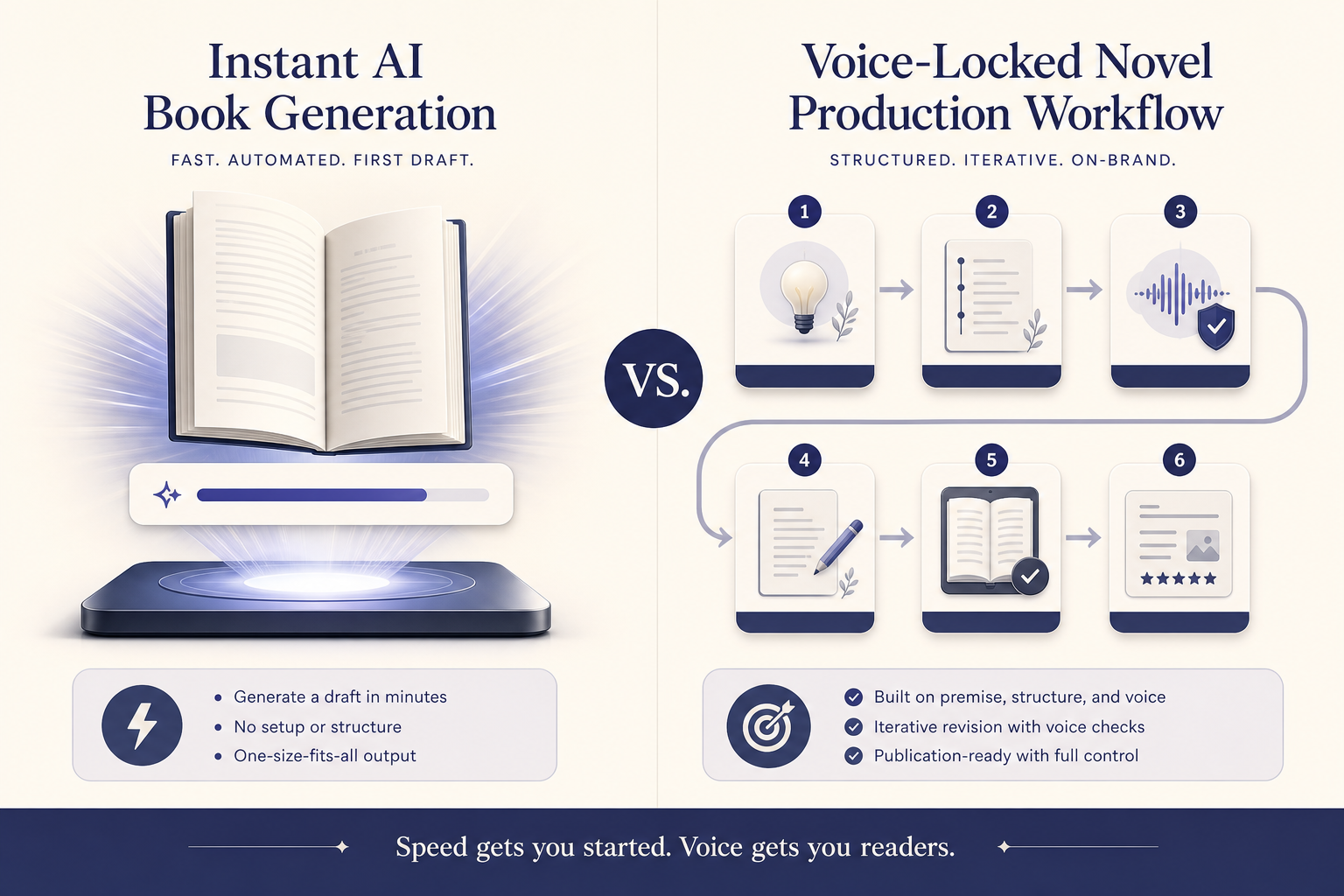
Squibler has one of the clearest promises in the AI writing category: turn an idea into a book.
That is a strong promise because it aims at the same pain StoryForge cares about. Writers do not just want clever paragraphs. They want finished books.
So this comparison is closer than most.
Squibler is trying to help writers generate and organize books, novels, and screenplays with AI. StoryForge is built specifically for AI-assisted novel production, with voice consistency, chapter workflow, export, and publishing metadata in one pipeline.
The difference is not whether AI can make a draft.
The difference is what happens after the draft exists.
The short version
Squibler is a broad AI book and screenplay writing platform.
StoryForge is a focused AI-native novel engine for indie authors.
| Question | Squibler | StoryForge |
|---|---|---|
| Best fit | Broad book, novel, and screenplay generation | Fiction-first novel production |
| Core promise | Generate and refine long-form work | Premise to published novel |
| Visuals | Includes image and visual generation | Images are not the core product |
| Voice workflow | Author-guided | Voice-locked and checked through the pipeline |
| Publishing handoff | Tool-assisted writing and organization | EPUB and metadata are part of the workflow |
If you want a broad writing platform that can touch books, screenplays, visuals, and project organization, Squibler is worth understanding.
If you want a focused system for producing novels that hold voice across chapters, StoryForge is the sharper tool.
Where Squibler is strong
Squibler is positioned around book and novel creation. Its public product pages describe full-length book generation, screenplay generation, story outlines, smart writing, element creation, visuals, project management, and templates.
That is a real set of features.
Squibler may fit writers who want:
- a broad AI writing platform
- book and screenplay support
- fast first drafts
- visuals alongside writing
- project organization
- templates and smart writing tools
For a new writer who wants to go from blank page to something tangible quickly, that can be appealing.
The full-book trap
"Generate a book" sounds like the finish line.
It is not.
For serious authors, the first complete draft is where the real work starts.
You still need to know:
- Does the voice hold after the opening?
- Did the character arc survive the middle?
- Are the chapter promises paid off?
- Does the pacing sag?
- Did the AI introduce contradictions?
- Is the ending earned?
- Can this become a clean EPUB?
- Does the metadata match the actual reading experience?
That is why StoryForge focuses less on "generate the book fast" and more on "ship the book without quality collapse."
Speed is only useful if the manuscript survives review.
What StoryForge does differently
StoryForge is fiction-first.
It is not trying to be a screenplay tool, a general book platform, a visual creation suite, and a writing app at the same time.
The product is built around one core job:
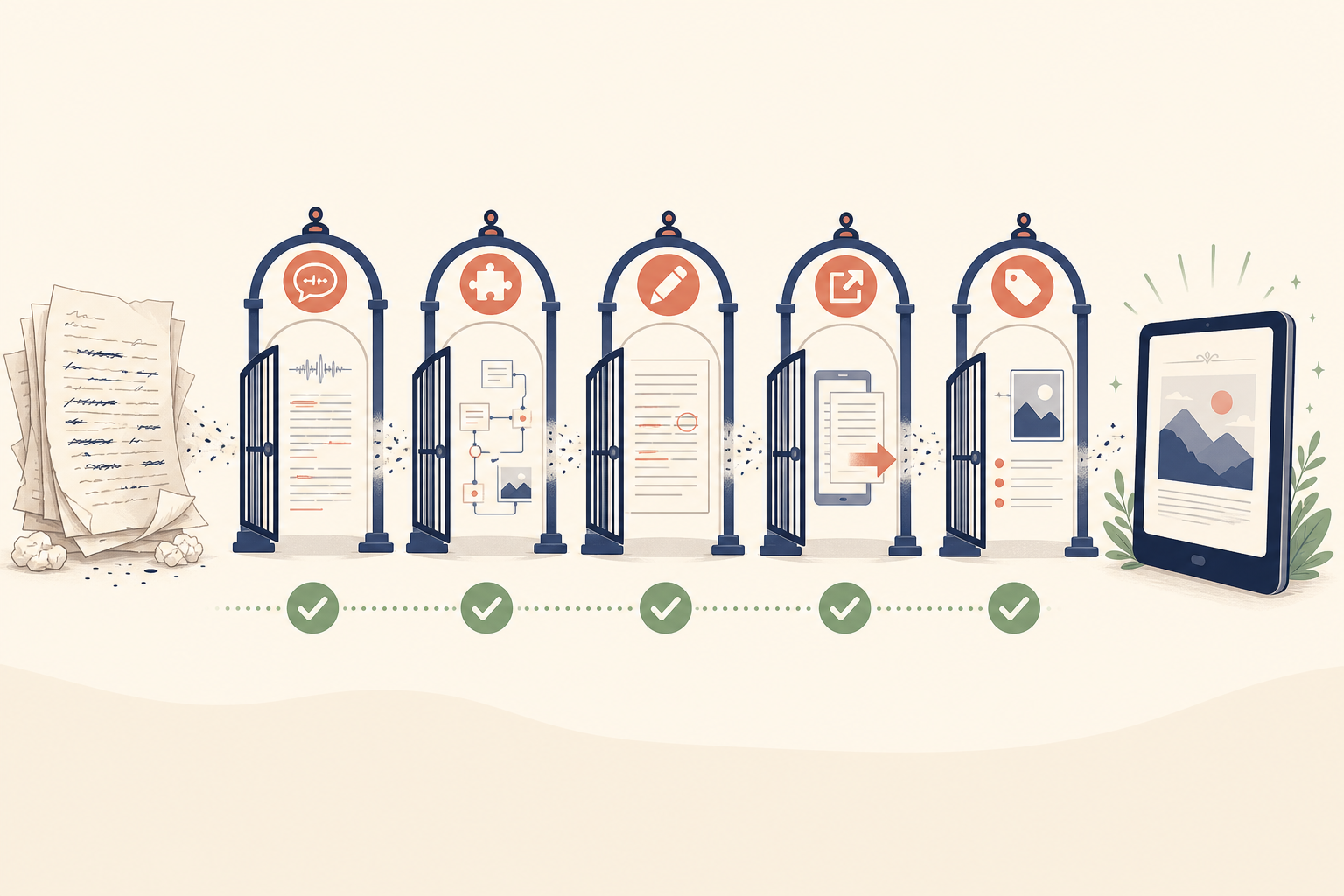
Take a novel from premise to publish-ready manuscript while preserving voice.
That means the workflow focuses on:
- commercial premise shaping
- outline structure
- voice definition
- chapter-by-chapter drafting
- continuity checks
- voice consistency
- revision
- EPUB export
- KDP-ready metadata
StoryForge does not win by having every possible writing feature.
It wins by making the novel production path tighter.
The voice problem matters more than the draft
The easiest way to misunderstand AI fiction is to judge the first page.
The first page can be good. The first chapter can be good. A generated outline can look clean.
The real test is whether chapter 18 still sounds like chapter 2.
This is where generic full-book generation gets risky. The book can be complete and still not be usable.
The prose might flatten. The character might start speaking in generic AI rhythm. The genre promises might blur. The author might spend more time repairing drift than they saved by generating quickly.
StoryForge is built to fight that failure mode.
Voice is not treated as decoration. It is part of the production system.
Broad platform or sharper workflow
Squibler's breadth can be useful.
It talks to authors, screenwriters, and people working across different long-form formats. It includes visuals and project management alongside writing. That can make sense if you want one broad creative workspace.
StoryForge is narrower by design.
It is not trying to be the best screenplay tool. It is not trying to be a visual generation suite. It is not trying to be a general writing app for every possible format.
The target is the indie novelist who wants to ship a book that reads like one author wrote it.
That focus changes product decisions.
StoryForge puts more weight on voice, chapter workflow, revision, export, and metadata because those are the parts that decide whether an AI-assisted novel can actually leave the tool and become a product.
If you want breadth, Squibler may be attractive.
If you want a tighter novel machine, StoryForge is the better bet.
The review burden
Every AI writing tool creates a review burden.
The honest question is how much of that burden the product carries.
If a tool gives you a fast draft, you still need to inspect the draft. If the story has continuity holes, the author pays for that later. If the voice drifts, the author pays for that later. If the export is not ready, the author pays for that later.
StoryForge tries to move those checks upstream.
The goal is not to pretend review disappears. The goal is to make review more structured, so the author is not wandering through a full manuscript asking, "Why does this feel off?"
That is what working authors need.
Not less responsibility.
Better leverage.
Choose Squibler if
Squibler is probably the better fit if:
- you want a broad AI writing suite
- you write both books and screenplays
- you value visuals as part of your drafting process
- you want fast full-book generation as a starting point
- you want project management plus writing tools in one workspace
That is a reasonable choice for exploratory writers.
Choose StoryForge if
StoryForge is probably the better fit if:
- you are focused on novels
- you care about voice consistency across the full manuscript
- you want a guided path from premise to published novel
- you need revision, export, and metadata in the same pipeline
- you are writing for KU, series velocity, ghostwriting, or catalog growth
The more your income depends on finished fiction, the more the workflow matters.
A fair decision rule
Pick Squibler if you want a broad AI writing platform that can generate and organize different kinds of long-form projects.
Pick StoryForge if you want a focused novel production system built around voice, continuity, export, and publishing.
Generating a book is not the same as shipping a book.
StoryForge is built for the shipping part.
Ready to turn a book idea into a publish-ready manuscript?
Start your free trial