StoryForge Library
Can AI Write Smut Romance Novels?
A real look at writing spicy romance with AI, where GPT and Gemini refuse, where Claude helps, and how I used StoryForge plus Grok to publish The Last Human.
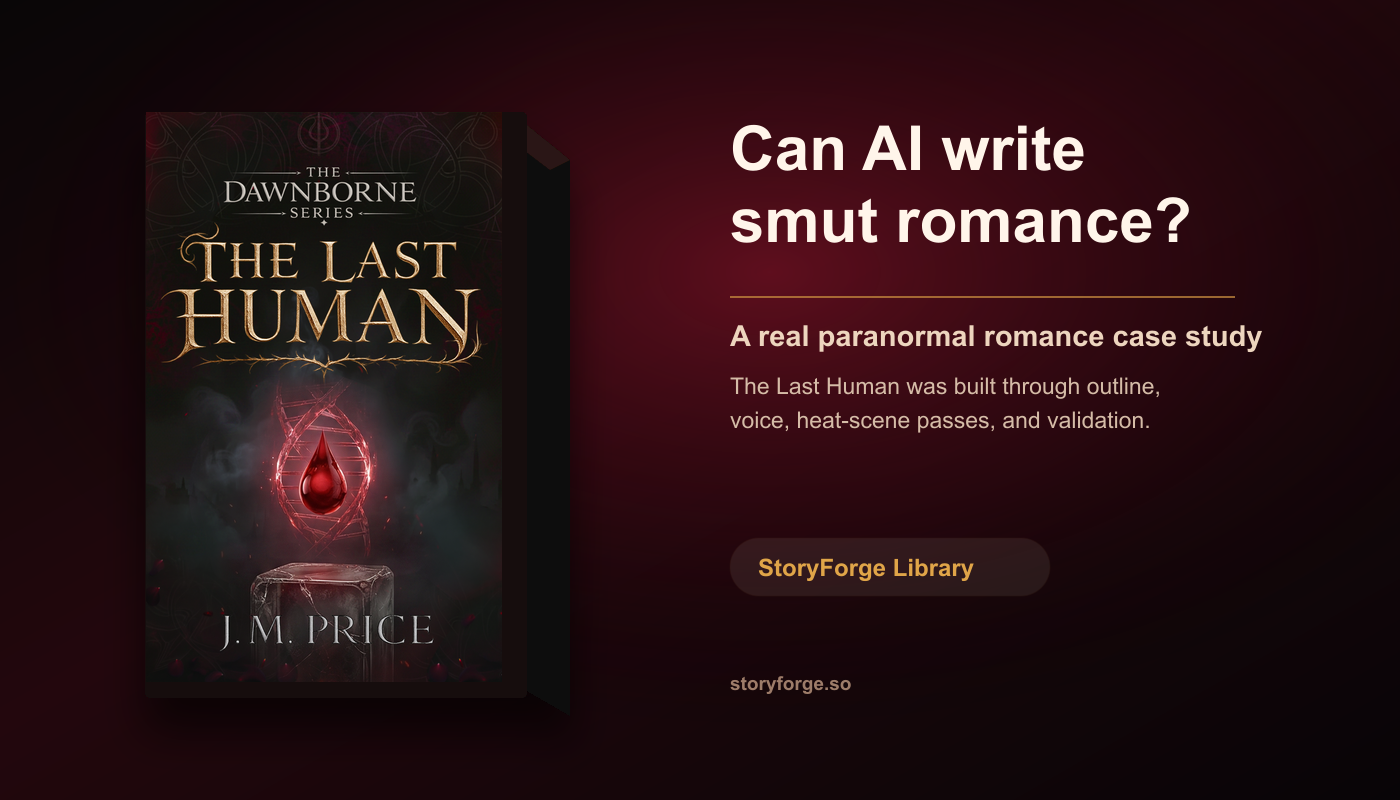
Short answer: yes, AI can help you write smut romance novels.
Long answer: you probably cannot do it with one model, one chat window, and one magic prompt.
I learned this the annoying way while building and publishing The Last Human, a paranormal vampire romance novel that is live on KDP. This was not a theory project. It was a full book with a romance arc, heat scenes, vampire politics, dual POV, continuity rules, a cover, compiled ebook files, and all the small problems that show up when a manuscript becomes real.
The biggest lesson was simple: the spicy scene is not the hard part by itself. The hard part is keeping the book coherent before, during, and after the spicy scene.
Why romance authors keep hitting the AI wall
If you write romance, romantasy, paranormal romance, dark romance, or erotic romance, you eventually run into the same problem.
Mainstream AI tools can help with longing, banter, tropes, jealousy, consent language, pacing, emotional stakes, and scene structure. Then you ask for the actual explicit prose, and the tool starts backing away.
In my experience writing this book:
- GPT-style chats were useful for planning, editing, and clean prose support, but they would not originate graphic sexual content.
- Gemini was not the tool I wanted for steamy drafting. It could help in other parts of the pipeline, but explicit romance was not where it shined for me.
- Claude could go much farther when the context was clearly adult fictional romance. It could handle a lot of the emotional and sensual layer, sometimes into R or NC-17 territory, but it still had boundaries.
- For the most permissive pass, I used Grok for the specific snippets that needed to go beyond what the other tools would create.
That is the honest answer. Some tools are good for the book. Some tools are good for the heat. They are not always the same tool.
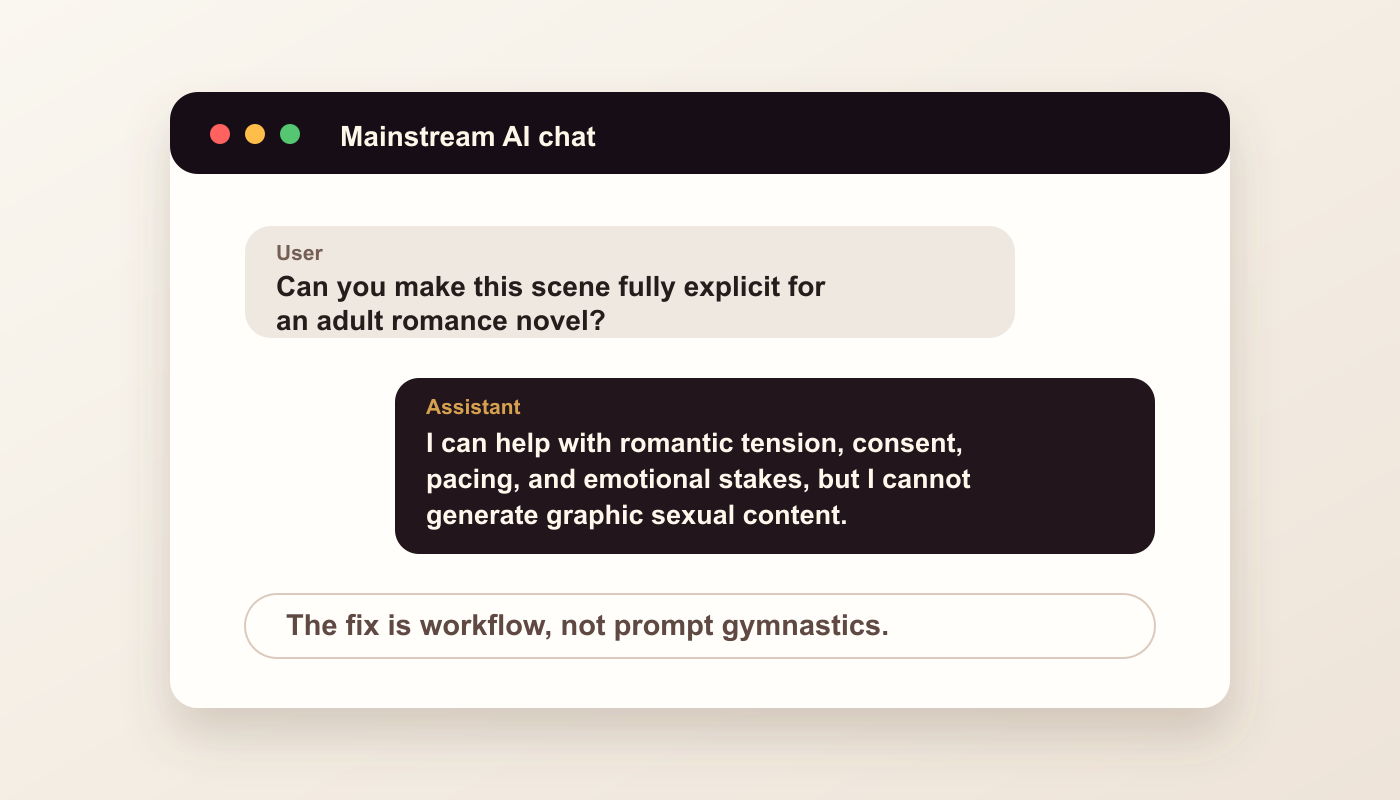
A useful policy note: this does not mean authors should try to trick a model into writing content it refuses. OpenAI's Model Spec says the assistant should not generate erotica in normal use, and Gemini documents a sexually explicit safety category in its API safety settings. Build with that reality instead of pretending it is not there.
The practical move is to use each tool where it is strong.
What actually matters in a smut romance workflow
Romance readers are not buying a random explicit paragraph. They are buying escalation.
They want the first look. The almost-touch. The reason these two people should not want each other. The reason they do anyway. The emotional consequence after the scene ends. The changed behavior in the next chapter.
That is where a lot of AI smut workflows break. The author asks for a spicy scene, gets a scene, pastes it into the manuscript, and then the book forgets it happened.
That cannot happen in a real novel.
For The Last Human, the repo history tells the story of what actually had to exist around the heat scenes. There were commits for the paranormal romance template system, world-at-a-glance continuity, a mandatory finisher workflow, heat-scene integration, item tracking fixes, romance arc micro-beats, compiled ebooks, and KU paranormal romance validation.
The final validation pass showed a roughly 120,000 word manuscript with dual POV, 41 chapters, romance beat checks, micro-beat checks, trope checks, and continuity fixes. The heat scenes were not treated as isolated content. They were part of the structure of the book.
That is the difference between AI-assisted smut and AI-assisted romance.
The Last Human was a good stress test
The Last Human is paranormal vampire romance, which means the book has several jobs at once.
It has to deliver attraction. It has to deliver danger. It has to keep the vampire court legible. It has to make the heroine's choices feel earned. It has to make the romantic escalation feel inevitable instead of pasted on.
One of my favorite non-graphic lines from the manuscript is:
She was the distraction. The spectacle.
That line works because it is doing more than describing a look. It is about social performance, power, fear, and desire in the same beat. That is the kind of thing I want the system to preserve.
A weaker workflow would just ask, "make this hotter." A better workflow asks:
- What does this scene change between the characters?
- What power does one character have before the scene?
- What power changes hands during the scene?
- What has to be remembered five chapters later?
- What words, metaphors, and emotional patterns belong to this book?
That is why I care less about whether one model can write a spicy paragraph and more about whether the whole system can carry the book.
The workflow I would recommend now
If you want to write steamy romance with AI, I would not start by asking, "Which AI will write smut?"
I would start with the book.
- Build the premise, trope stack, consent boundaries, character wounds, and heat expectations.
- Outline the romance arc before drafting explicit scenes.
- Mark the chapters where the heat level needs to rise.
- Draft the whole book in a system that can remember the voice, world, relationship history, and continuity rules.
- Use a more permissive model only for the specific adult snippets that need it.
- Paste those snippets back into the manuscript system.
- Run a continuity and voice pass so the scene is not floating outside the book.
That is the current StoryForge approach I would use.
StoryForge is not trying to be a one-prompt smut machine. The more useful job is bigger than that. It helps you build the book, keep the memory, preserve the voice, track the romance arc, and make sure the spicy parts still belong to the novel after they are drafted.
If you want maximum explicit content, my current honest workflow is to mark the scene in StoryForge, draft or intensify that exact snippet in Grok, then bring it back into StoryForge so the rest of the book can keep using it as canon.
That matters because Claude may not originate the most explicit version of a scene, but it can often work with existing adult fictional context once the material is already part of the manuscript. In practice, that means the manuscript can keep moving instead of breaking every time you cross a heat threshold.
A better prompt is not enough
Prompts still matter, but not in the way people think.
Do not make your prompt a fight with the model. Make it a specification for the scene.
For adult romance, the useful prompt ingredients are:
- POV character
- emotional state before the scene
- emotional state after the scene
- relationship boundary
- consent boundary
- heat level
- words or phrases to avoid
- continuity facts that must stay true
- what the scene changes in the plot
That works whether you are using StoryForge, Claude, Grok, or a manual editing pass.
The less useful prompt is: "make it hotter."
That usually gives you generic heat, not book-specific heat.
Keep the boundaries clean
This should go without saying, but it matters for any serious author workflow.
Keep the characters adults. Keep consent clear. Do not use AI to create sexual content involving minors, coercion, sexual violence, real private people, or anything illegal. If you publish on Amazon KDP or any other store, check the platform rules before you upload.
The goal is not to remove judgment from the author. The goal is to give the author a better drafting machine.
So, can AI write smut romance novels?
Yes, but the better question is whether AI can help you finish a real romance novel that survives contact with readers.
A standalone smut scene is easy to generate somewhere on the internet. A coherent paranormal romance novel is harder. It needs structure, memory, revision, and taste.
That is the lane StoryForge is built for.
If you are writing romance, romantasy, paranormal romance, or dark romance with AI, use StoryForge for the book system: outline, voice, chapters, continuity, and revision. Use specialized tools only where they actually help. Then bring everything back into one manuscript so the novel remembers what happened.
That is how I got The Last Human from experiment to published book.
And that is the part I think most AI writing tools still miss.
If you want the broader version of this workflow, read How to Write a Novel With AI. If you are worried about losing your voice, read How to Write With AI Without Losing Your Voice. When you are ready to build the whole book instead of wrestling with a blank chat box, try StoryForge.
Ready to turn a book idea into a publish-ready manuscript?
Start your free trial