AI Novel Writing
How to write a novel with AI
A practical guide to writing a novel with AI, where ChatGPT helps, where it breaks down, and why serious authors need a structured book workflow.
How to write a novel with AI

The honest answer is that AI can help you write a novel.
The less honest answer is that you can open ChatGPT, type "write me a novel," and expect the result to feel like a real book.
That is where a lot of writers get burned.
AI is useful for fiction. It is especially useful when you treat it like a production partner instead of a magic box. It can help you brainstorm, outline, draft, revise, summarize, test angles, and generate publishing assets.
But a novel is not one prompt.
A novel is a long memory problem. It is a voice problem. It is a continuity problem. It is a pacing problem. It is a file and revision problem. If you ignore that, the manuscript starts fine and then slowly turns into something that does not quite feel like yours.
This is the practical way I would think about writing a novel with AI.
Start with the job, not the tool
Before picking a tool, define the job.
Are you trying to:
- brainstorm a story idea
- build a commercial premise
- outline a complete book
- draft one chapter
- revise a messy chapter
- keep a series consistent
- export a publish-ready manuscript
- create metadata for KDP
Those are different jobs.
ChatGPT can help with many of them. So can Claude. So can Sudowrite, NovelCrafter, Squibler, and other AI writing tools.
But the tool matters less than the workflow.
If the workflow is weak, AI just helps you create more material to manage.
Where ChatGPT is genuinely useful
ChatGPT is good for one chapter at a time.
If you give it a clear setup, a strong scene goal, character context, tone guidance, and a specific output request, it can help you get useful prose or at least a useful starting point.
For example, ChatGPT can help you:
- brainstorm five different openings
- turn a beat into a rough scene
- rewrite a paragraph in a cleaner rhythm
- summarize a chapter you already wrote
- identify weak stakes in a scene
- generate title and blurb directions
- test whether a premise has obvious market problems
That is real value.
I do not think authors should pretend direct chat is useless. It is not.
For a single scene, a single chapter, or a single problem, ChatGPT can feel fast and powerful. It gives you motion when the blank page is winning.
For a direct breakdown of that tradeoff, read StoryForge vs ChatGPT for writing a novel.
The problem starts when you ask it to carry the whole book.
Why direct chat starts breaking over time
A novel has state.
That state includes:
- who the characters are
- what they want
- what they know
- what they have promised
- what changed in each chapter
- what the reader is waiting for
- what the prose should sound like
- what the book is building toward
In a direct chat workflow, you are the one carrying most of that state.
You paste summaries. You remind the model what happened. You correct the same continuity issues. You re-explain the voice. You tell it not to resolve the subplot yet. You ask why the character suddenly sounds different. You copy material into docs. You decide which version is canonical.
That can work for a while.
Then the book gets longer.
Chapter 2 sounds pretty good. Chapter 5 is usable. Chapter 11 starts to feel generic. Chapter 17 forgets the emotional pressure that made chapter 3 matter.
At that point, better prompting helps only a little.
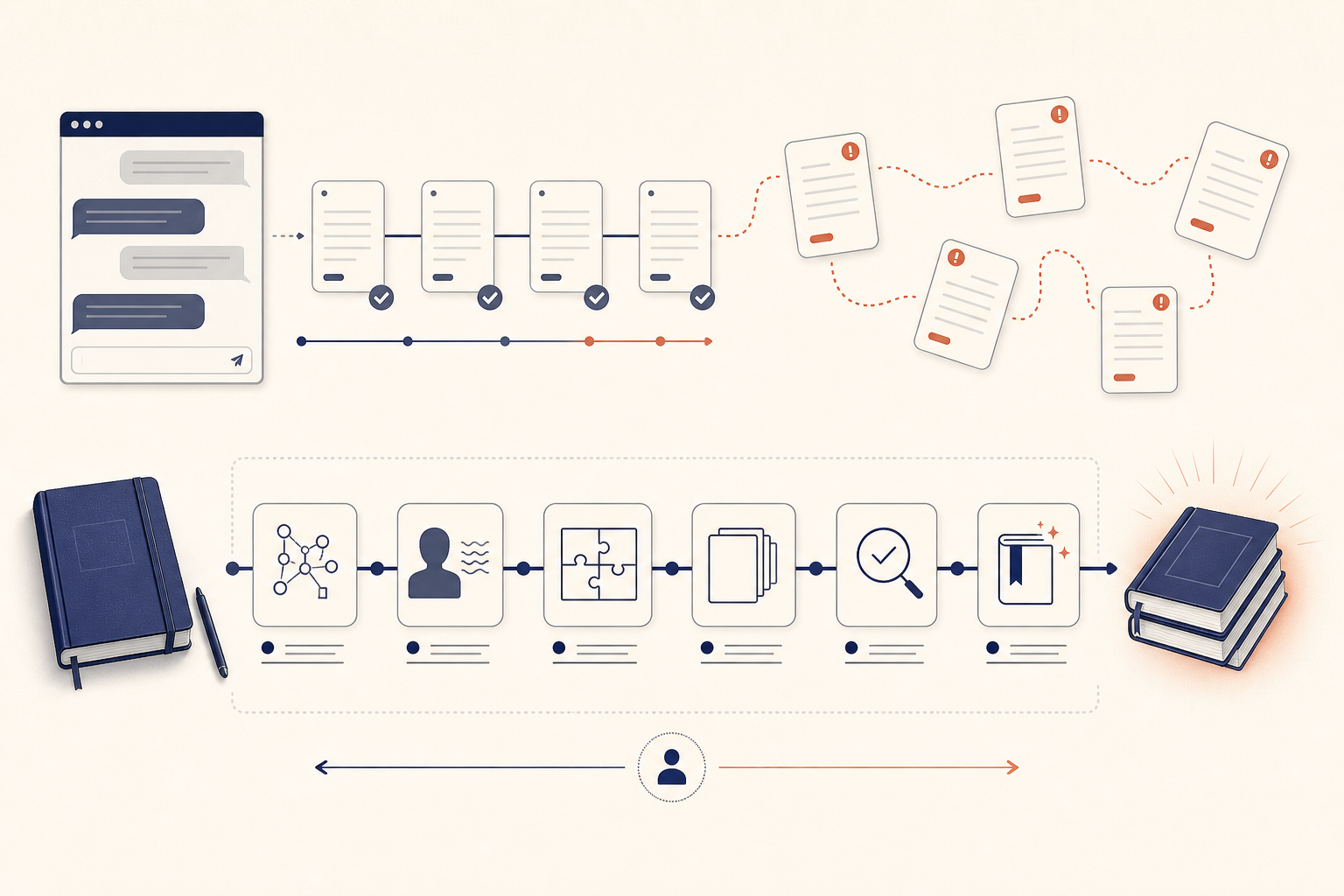
The deeper issue is that the novel needs a system.
The author becomes the operating system
This is the hidden cost of writing a novel in ChatGPT.
The author becomes the operating system.
You manage the outline. You manage the canon. You manage the character files. You manage the voice rules. You manage the revision queue. You manage exports. You manage metadata. You manage the pile of prompts that worked once but do not quite work again.
That might be fine if you enjoy building your own writing machine.
Some authors do.
But most authors want the machine to help them finish the book.
There is a difference between getting AI output and having a novel production workflow.
Other tools authors are trying
Authors are experimenting everywhere right now.
They are using ChatGPT for flexible brainstorming and chapter help. They are using Claude for long-context thinking, manuscript feedback, and prose analysis. They are using Sudowrite for scene-level fiction support. They are using NovelCrafter for planning, codex-style organization, and bring-your-own-model workflows. They are using Squibler and other book generators when they want a faster full-draft experience.
Each tool has a lane.
If you are comparing specific options, start with StoryForge vs Sudowrite, StoryForge vs NovelCrafter, and StoryForge vs Squibler.
The common pattern is that authors start with direct chat because it is easy. Then they hit the wall where the book becomes too complex to hold in a thread. Then they start adding docs, spreadsheets, folders, outline apps, prompt libraries, and writing software around the AI.
At that point, the author is not using one AI writing tool.
They are building a production stack by hand.
What a real AI novel workflow needs
If I were designing the workflow from scratch, I would not start with a blank prompt box.
I would start with the production path:
- Premise
- Genre and reader promise
- Outline
- Character arcs
- Voice profile
- Chapter beats
- Drafting
- Revision
- Continuity checks
- Export
- Metadata
That is the job.
The AI should support the job instead of forcing the author to manually stitch it together.
This is why a purpose-built system starts to matter for serious books.
How StoryForge makes it possible
StoryForge is built around the belief that AI writing is useful, but AI production is the bigger opportunity.
The goal is not to replace the author.
The goal is to stop making the author rebuild the entire book context every time they sit down.
StoryForge keeps the work organized around the actual manuscript pipeline: premise, outline, voice, chapters, revision, export, and publishing metadata. The author still makes the creative decisions. The system keeps the book from turning into scattered prompts and disconnected drafts.
That is the real difference.
ChatGPT can help you write a chapter.
StoryForge is built to help you finish the book.
A simple way to use AI without losing control
If you are writing with AI today, use this rule:
Do not let the AI be the source of truth.
Your outline, character decisions, voice rules, chapter summaries, and manuscript files need a stable home. If that home is a folder and a spreadsheet, fine. If it is a dedicated writing tool, fine. If it is StoryForge, that is exactly what we are building for.
But do not trust a chat thread to be the whole system.
That is how books drift.
The voice problem deserves its own treatment, so I also wrote how to write a novel with AI without losing your voice.
My recommendation
Use ChatGPT for fast thinking.
Use it for brainstorming, rough scenes, alternate lines, summaries, and problem solving.
But if you are serious about writing and publishing a complete novel, build or use a workflow that can hold the entire book.
That workflow needs memory, structure, voice, continuity, revision, export, and metadata.
That is what makes AI novel writing actually useful.
And that is what StoryForge is designed to do.
Ready to turn a book idea into a publish-ready manuscript?
Start your free trial