StoryForge Library
Why indie authors need a real novel outline
A real novel outline helps indie authors deliver tropes, reader expectations, and series momentum before the draft becomes an expensive edit.

A novel outline for indie publishing is not busywork. It is where you decide what kind of reader promise you are making, which tropes you are going to deliver, what every major turn has to earn, and what can safely be cut before it becomes an editing bill.
This matters even more if you are writing for a 20BooksTo50K-style career, where the point is not one precious book every few years. The point is a catalog that keeps readers moving from one book to the next.
If the outline is weak, the draft gets expensive.
The outline is not the boring part
Most writers think of the outline as the document you make before the real work starts.
That is backwards.
The outline is where the hard commercial decisions happen.
If you write cozy mystery, the outline decides when the body drops, when the sleuth gets pulled in, which suspects carry plausible motives, where the false solution lands, and how the reveal pays off.
If you write romantasy, the outline decides the promise of the pairing, the pressure of the world, the required intimacy beats, the betrayal or sacrifice, and the reason the reader keeps turning pages after the first kiss.
If you write LitRPG, the outline decides the progression loop, the power ceiling, the stat reveals, the dungeon or quest escalation, and the moment the reader feels the build was worth it.
Those are not decoration. They are the product.
Readers do not always describe these expectations in craft language, but they feel them immediately. They know when the book wandered. They know when the trope was advertised but not delivered. They know when the midpoint did nothing. They know when the ending technically resolves the plot but fails the emotional contract.
That is why a good outline is not a cage. It is a reader-promise ledger.
The 20BooksTo50K lesson is catalog discipline
The 20BooksTo50K idea is often discussed as a catalog strategy: publish enough books that readers have multiple paths through your work, then keep improving the business around that catalog. ScribeCount has a current overview of the 20BooksTo50K community and its indie-author publishing focus, and Author Nation now carries much of the same pro-indie, business-first energy for working authors.
That model does not mean every author must publish at the same pace. It does not mean twenty books magically creates income. It does mean the economics change when you stop thinking about one book and start thinking about a shelf.
A shelf punishes chaos.
One messy book can be fixed in edits. A messy series compounds the problem. You forget the promise of book one. You drift away from the trope that sold the reader in the first place. You introduce a subplot because it felt interesting on Tuesday, then spend three weeks trying to make it matter. You build a cast too large to track. You write scenes that are good in isolation but dead weight in the release calendar.
That is the trap for solo indie authors. You are author, developmental editor, continuity manager, market analyst, production manager, and sometimes cover designer. Without a strong outline, every role starts fighting every other role.
The draft gets louder. The book does not get clearer.
Tropes are not cheap. They are navigation
Bad writing advice treats tropes like formulas.
Serious indie authors know better.
A trope is a reader navigation tool. It tells the reader which emotional machine they are stepping into.
Enemies to lovers is not just two characters being rude to each other. It requires attraction under conflict, real ideological friction, forced proximity or recurring collision, moments where the mask slips, a believable reason they cannot simply walk away, and a payoff where the earlier hostility becomes part of the intimacy.
Found family is not just a group of friends. It requires isolation, earned trust, a choice to stay, a test of loyalty, and a scene where the new bond costs something.
Chosen one is not just prophecy. It requires burden, denial, training or discovery, public pressure, private fear, and a final decision that turns assignment into agency.
When you outline properly, you do not just write "include trope." You map the required beats so the trope pays off in the reader's body.
That is the difference between using tropes and name-dropping tropes.
The weeds are where solo authors lose the book
Writing alone has one huge advantage: total control.
It also has one huge problem: total control.
Nobody stops you from spending three days designing a minor city that appears twice. Nobody stops you from adding a villain backstory that weakens the central threat. Nobody stops you from writing a beautiful chapter that delays the thing the reader came for.
You can get lost because everything feels important while you are inside the draft.
The outline gives you a way to ask better questions before you spend the words.
- Does this scene change the relationship, the plot, or the reader's understanding of the promise?
- Does this subplot increase pressure on the main story?
- Does this trope get setup, escalation, reversal, and payoff?
- Does the midpoint force a new plan?
- Does the ending answer the question the opening asked?
- Does this book move the series forward without making the reader do homework?
Those questions are cheaper before chapter one exists.
They are still answerable in edits, but now you are cutting pages, rewriting transitions, fixing continuity, and trying not to resent the book.
A good outline saves the edit
Editing is where weak planning sends the invoice.
If the outline did not define the reader promise, the developmental edit has to discover it. If the outline did not track tropes, the edit has to retrofit them. If the outline did not enforce cause and effect, the edit becomes a rescue mission.
That is expensive whether you are paying an editor or paying with your own time.
Most AI writing workflows make this worse. A chat box will happily help you write the next scene. It will also happily help you write the wrong next scene, because it does not know your business goal, release cadence, genre promise, continuity ledger, trope stack, or series plan unless you keep feeding all of that back into the window.
That is why direct chat can feel productive while quietly making the book harder to finish.
You get words. You do not always get a book.
How AI should help with outlining
AI should not replace the author's taste.
It should keep the author from losing the shape of the book.
The useful job for AI is not "give me random ideas." That is the easiest part. The useful job is constraint management.
When you say you want a grumpy sunshine small-town romance, the system should know what that usually asks of the book. It should help you define the wound, the contrast, the forced proximity, the community pressure, the moment of softening, the breakup logic, and the grand gesture or equivalent payoff.
When you say you want a fast KU thriller, the system should keep pressure on chapter endings, suspect turns, reversals, and the main investigative spine.
When you say you want book four in a series, the system should protect the continuity from books one through three and stop you from accidentally treating the cast like they just met.
That is the actual value.
Not more brainstorming. Better boundaries.
How StoryForge handles the planning layer
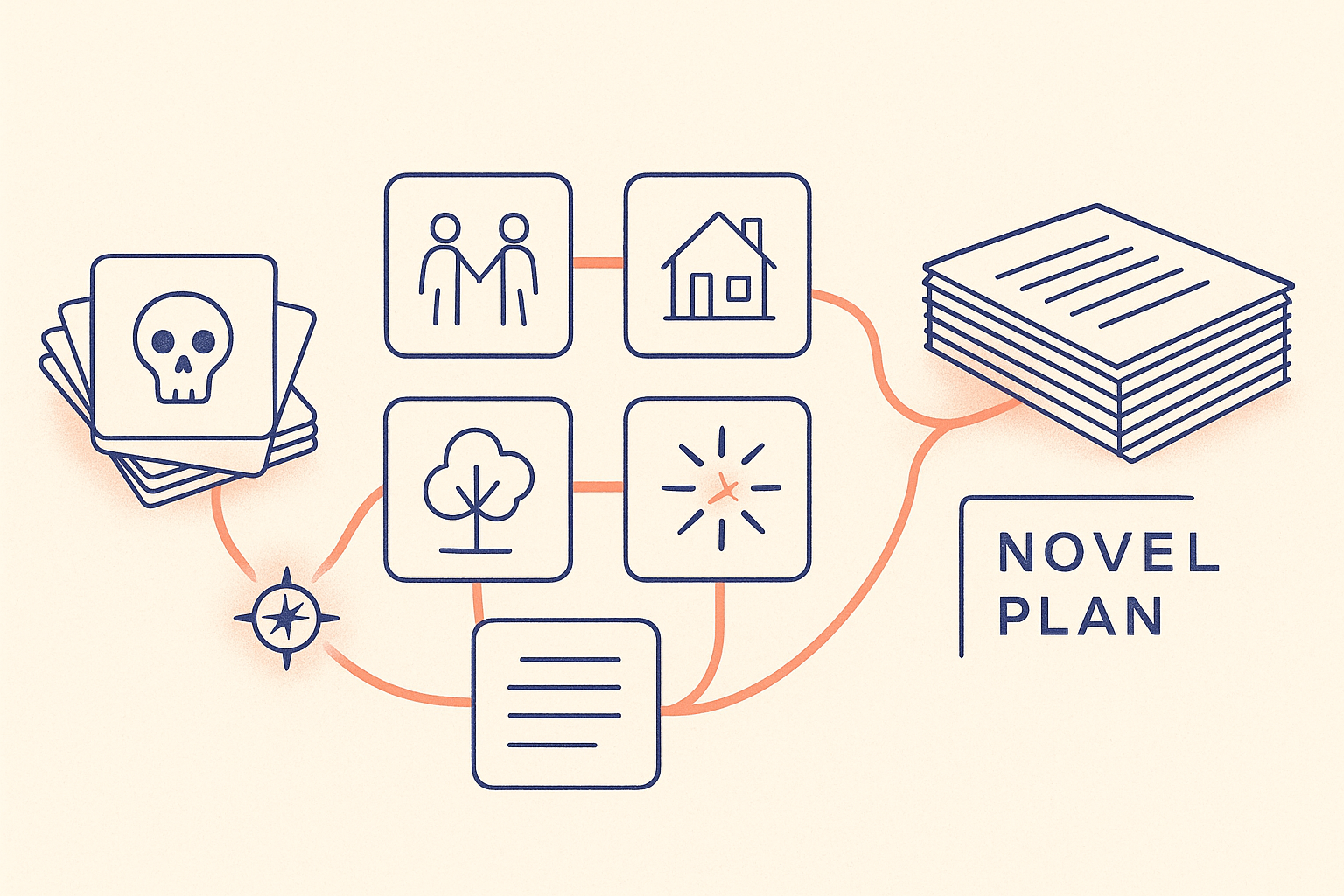
StoryForge is built around the idea that a novel is not a pile of scenes. It is a chain of decisions.
The product guides those decisions before drafting starts. Premise, genre, trope stack, character pressure, voice, continuity, scene purpose, chapter flow, and publish path all feed the same book system.
That means the outline is not a disposable prep file. It becomes the operating plan for the draft.
If you want a trope, StoryForge helps package it into beats readers can actually feel. If you want a character choice, StoryForge pushes it through motivation, consequence, and continuity. If you want a certain kind of ending, StoryForge keeps the earlier chapters pointed at that payoff instead of letting the manuscript drift into whatever looked interesting in the moment.
The point is not to make every book identical.
The point is to stay on the beaten path long enough that the reader gets what they came for, while your voice and premise make the book yours.
That matters because serious indie publishing is not just writing. It is production.
Production needs taste, but it also needs rails.
The practical rule
If you are writing one experimental book for yourself, outline however you want.
If you are writing for readers, especially in a genre where reader expectation drives reviews, read-through, and series momentum, outline the book like it has a job.
Before you draft, know:
- the core reader promise
- the genre lane
- the primary trope stack
- the character arcs
- the midpoint turn
- the third-act pressure
- the series continuity burden
- the scenes that must exist for the book to feel complete
- the scenes that are interesting but optional
Then draft.
You can still discover. You can still surprise yourself. You can still change the plan when the book earns it.
But now you are changing the plan with awareness, not wandering because the draft got loud.
The book gets easier when the decisions are guided
The promise of AI for indie authors is not that it makes taste unnecessary.
Taste becomes more important.
The difference is that AI can hold the map while you make the taste decisions. It can remind you what the genre needs. It can keep the trope from going missing. It can show you when a subplot stopped paying rent. It can keep book five from contradicting book two. It can help you see the book as a system instead of a pile of pages.
That is where StoryForge is focused.
Not a prompt box. Not a generic scene helper. A complete book workflow where the outline, voice, chapters, continuity, and final manuscript stay connected.
If you want the broader production workflow, read how to write a novel with AI. If you are worried that AI will flatten your style, read how to write with AI without losing your voice.
Production note: this article was drafted by Codex from the founder's brief, checked against StoryForge marketing guardrails, image-generated with GPT Images 2.0 style direction, and published through StoryForge's signed blog workflow because the topic is exactly where AI-assisted planning helps.
If you want StoryForge to guide the outline before the draft gets expensive, start your free trial.
Ready to turn a book idea into a publish-ready manuscript?
Start your free trial