StoryForge Library
Best AI Writing Tools for Authors in 2026
Most AI writing tools help with one slice of a book. Indie authors need a connected stack for outline, voice, continuity, drafting, and edits.
If you searched for the best AI writing tools for authors, the real question is probably not "which app can make words?" Every serious AI tool can make words now. The useful question is which tool stack can help you finish a book without losing the outline, the voice, the continuity, or the reader promise halfway through.
That is the gap most AI writing tool lists still miss.
Laterpress keeps a current roundup of AI writing tools for fiction writers, and the category is packed for a reason. Authors want help with brainstorming, drafting, rewriting, editing, metadata, and publishing. Tom's Guide made the same practical point about ChatGPT alone and long-form novel work: a chat box can be useful, but a novel needs more than the next answer in a thread.
The search is not really about tools
When authors search for AI writing tools, they usually want one of three things.
They want speed because the release calendar is real.
They want control because generic AI prose is easy to spot.
They want confidence because the book still has to survive readers, reviews, KDP disclosure, and series continuity.
That means the tool question is really a workflow question.
A KU romance author does not only need a paragraph generator. She needs a way to hold trope promise, relationship escalation, scene order, voice, continuity, and revision notes across the whole manuscript.
A cozy mystery author does not only need better sentence rewrites. He needs suspects, clues, false leads, chapter turns, and a reveal that was planted cleanly enough to feel fair.
A LitRPG author does not only need combat prose. They need progression, stats, inventory, party dynamics, power ceilings, and a world that does not contradict itself in book four.
If your AI stack only helps with one slice, the rest of the job falls back on you.
Most AI writing tools solve one slice
There is nothing wrong with single-purpose tools.
A brainstormer can help you find a premise. An outliner can help you shape the book. A rewrite tool can clean a paragraph. A grammar tool can catch obvious problems. A chatbot can help you think through a scene.
The problem starts when authors mistake those slices for a book system.
A finished novel has dependencies.
The outline affects the chapter draft. The character wound affects the dialogue. The trope promise affects the midpoint. The series bible affects every setting detail. The voice sample affects every paragraph. The ending affects what has to be planted in chapter two.
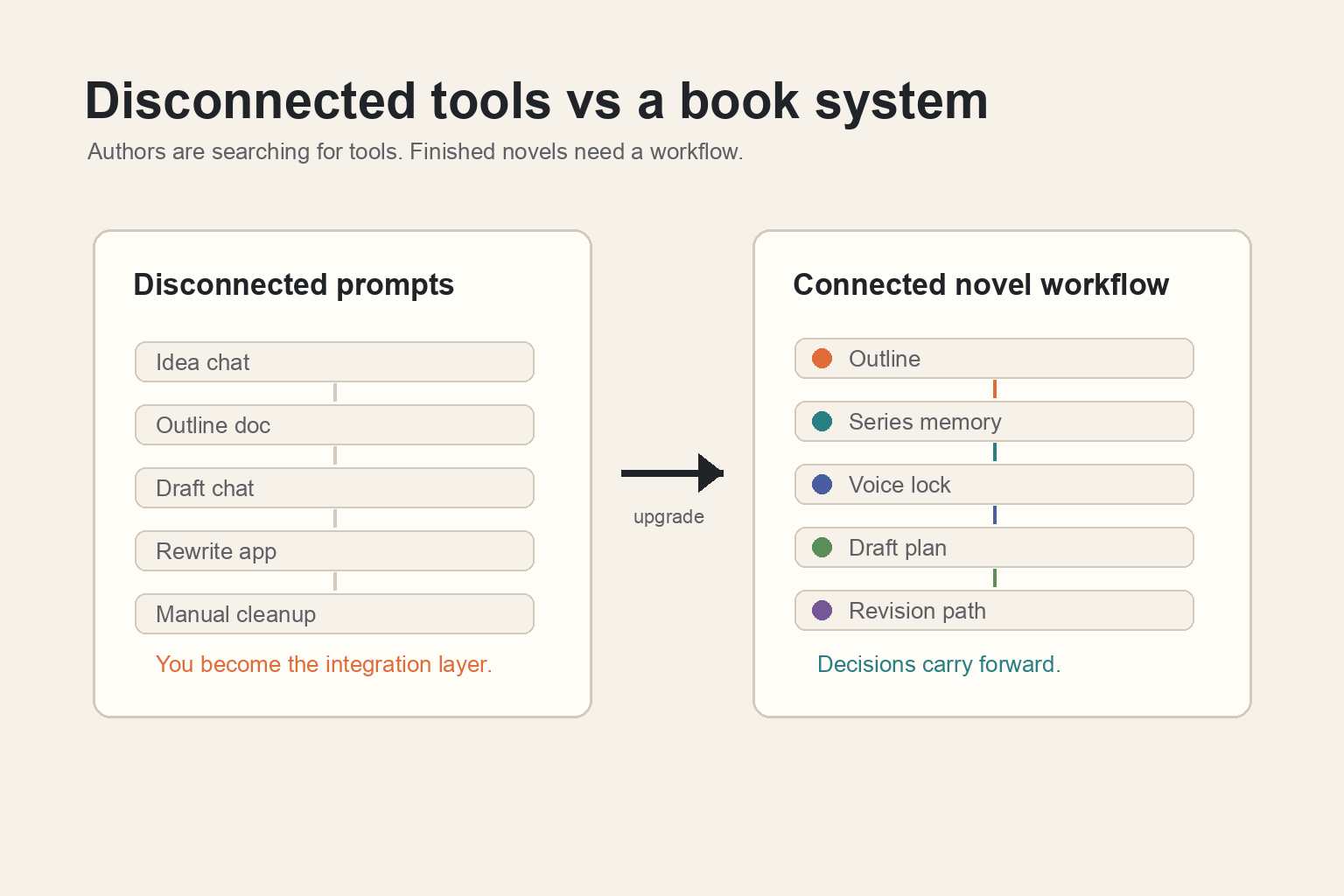
If those pieces live in disconnected tools, you become the integration layer.
That is doable for one short book. It gets expensive across a series.
The five jobs your AI writing stack has to cover
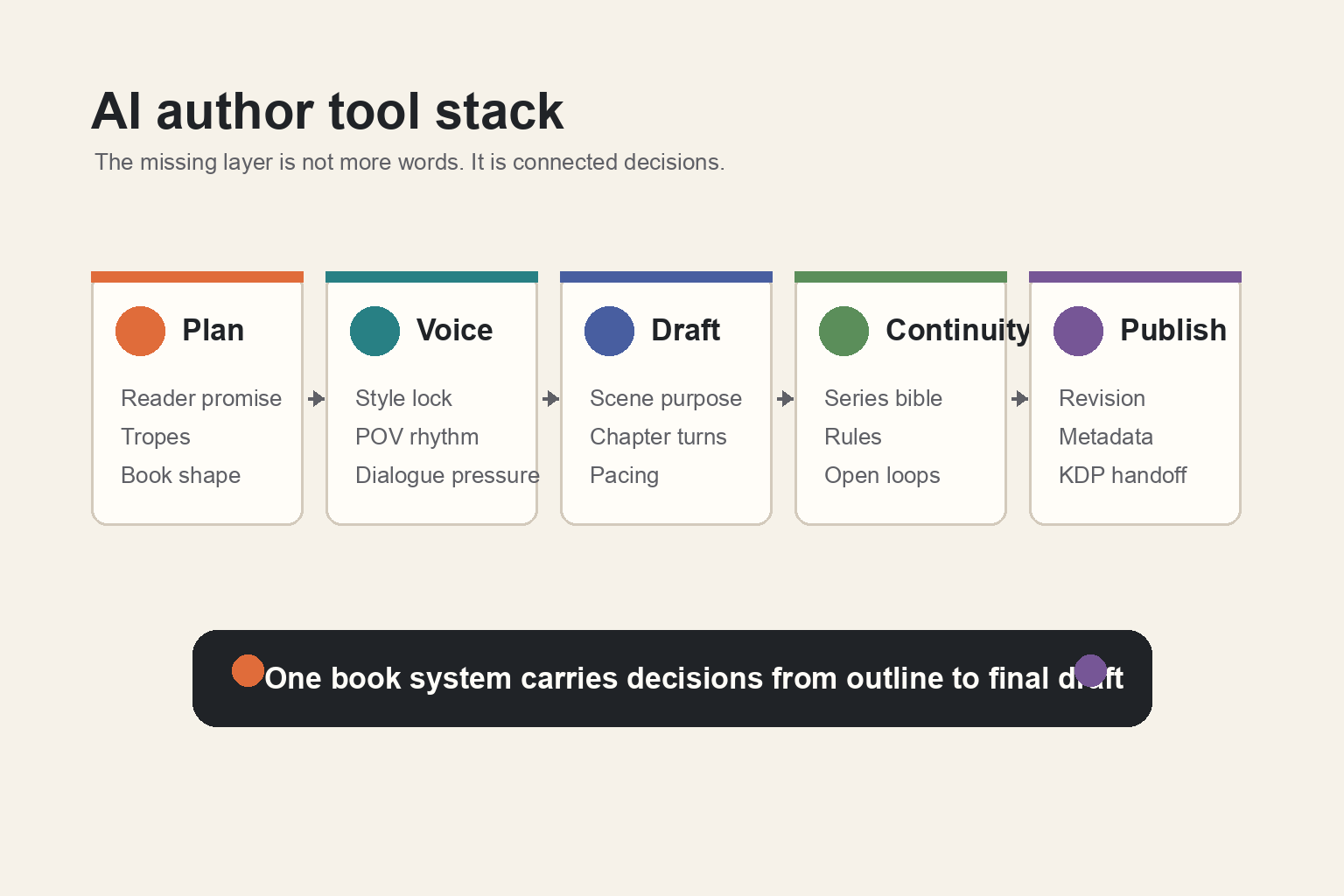
A practical AI author stack has to do five jobs well.
1. Plan the reader promise
Before drafting, the tool has to help define what the book is promising.
Genre is not a label you attach later. It decides what readers are waiting for.
If you are writing enemies to lovers, the book needs conflict, attraction, forced collision, softening, reversal, and payoff. If you are writing a murder mystery, the book needs a fair clue path. If you are writing progression fantasy, the power curve has to feel earned.
An AI tool that only asks for a vague premise will usually give you a vague book.
This is why the outline matters. If planning is your immediate problem, read why indie authors need a real novel outline.
2. Hold continuity across the book
Long-form fiction breaks when memory breaks.
Names drift. Backstory changes. A side character learns something twice. A magic rule gets bent because the current scene needed drama. A romantic conflict repeats because the previous scene was outside the chat window.
A useful AI tool has to remember the book as a system.
That means characters, locations, rules, prior decisions, series facts, and open loops need to remain available while the next scene is being drafted.
This is one reason direct chat starts strong and gets weaker as the book grows. If you want that comparison, read StoryForge vs ChatGPT for novel writing.
3. Lock the author voice
The obvious fear is that AI prose sounds generic.
The deeper fear is inconsistency.
A book can survive a plain sentence. It cannot survive sounding like three different writers took turns writing chapters.
Voice is not only word choice. It is sentence rhythm, interiority, image pattern, dialogue pressure, pacing, and how much the narrator explains versus implies.
If a tool cannot learn and preserve your voice, it is not really helping you produce a publishable novel. It is giving you raw material.
If this is your main concern, read how to write with AI without losing your voice.
4. Draft against the plan
Drafting is where weak tools look better than they are.
It is easy to generate a scene that sounds plausible. It is harder to generate the right scene for this book, this chapter, this character, this trope, and this series.
The tool should know why the scene exists before it writes it.
Does this chapter raise pressure? Does it turn the relationship? Does it plant a clue? Does it pay off an earlier promise? Does it advance the progression loop? Does it preserve the point of view voice?
If the tool cannot answer that, you are back to babysitting.
5. Support revision and publishing
AI-assisted writing does not stop when the draft exists.
You still need to revise for structure, continuity, voice drift, pacing, and KDP presentation. You still need clean metadata, a publishable file, and a manuscript that does not feel like stitched output.
A good stack should make the edit smaller, not bigger.
If AI gives you a pile of scenes and then you spend weeks forcing them into a book, the tool did not save you enough.
A simple test for any AI writing tool
Ask one question:
Can this tool carry decisions forward?
Not just remember a note. Carry decisions.
If you choose a trope, does it shape future scenes?
If you define a character voice, does it affect chapter ten?
If you change the outline, does the downstream draft plan move with it?
If book two establishes a rule, does book three respect it?
If you cannot trace a decision from planning to prose to revision, you are probably using a tool, not a system.
That might be enough for short-form writing. It is not enough for serious indie novel production.
Where StoryForge fits
StoryForge is built for authors who want the book system, not another prompt box.
The product connects the planning layer, voice layer, drafting layer, continuity layer, and publishing path. The goal is not to make every book formulaic. The goal is to keep the reader promise, author voice, and manuscript structure connected while the book moves from premise to finished draft.
That matters because indie publishing is production.
A working author needs taste, but taste is not enough when the release calendar is moving. You need rails. You need memory. You need a tool that knows the difference between a good sentence and the right next chapter.
Most AI tools can help you write something.
The better question is whether they help you finish the book.
The practical rule
If you are choosing AI writing tools this week, do not start with features.
Start with failure points.
Where do your books usually break?
If you lose the plot, prioritize planning and outline structure.
If your series facts drift, prioritize continuity.
If the prose sounds generic, prioritize voice.
If you can draft but not finish, prioritize revision workflow.
If you want to go from idea to published novel without stitching five tools together, prioritize a connected system.
That is the category StoryForge is building.
Production note: this article was researched with current search results, drafted by Codex from StoryForge marketing guardrails, checked for working source links and no em dashes, and published through StoryForge's signed blog workflow. I used automation because this is exactly the kind of tool-stack decision authors are trying to make.
If you want the planning, voice, drafting, continuity, and publish path in one workflow, start your free trial.
Ready to turn a book idea into a publish-ready manuscript?
Start your free trial