StoryForge Library
Can You Publish an AI Book on Amazon KDP in 2026?
Yes, authors can publish AI-written books on Amazon KDP in 2026, but disclosure, originality, quality, and workflow matter more than prompts.
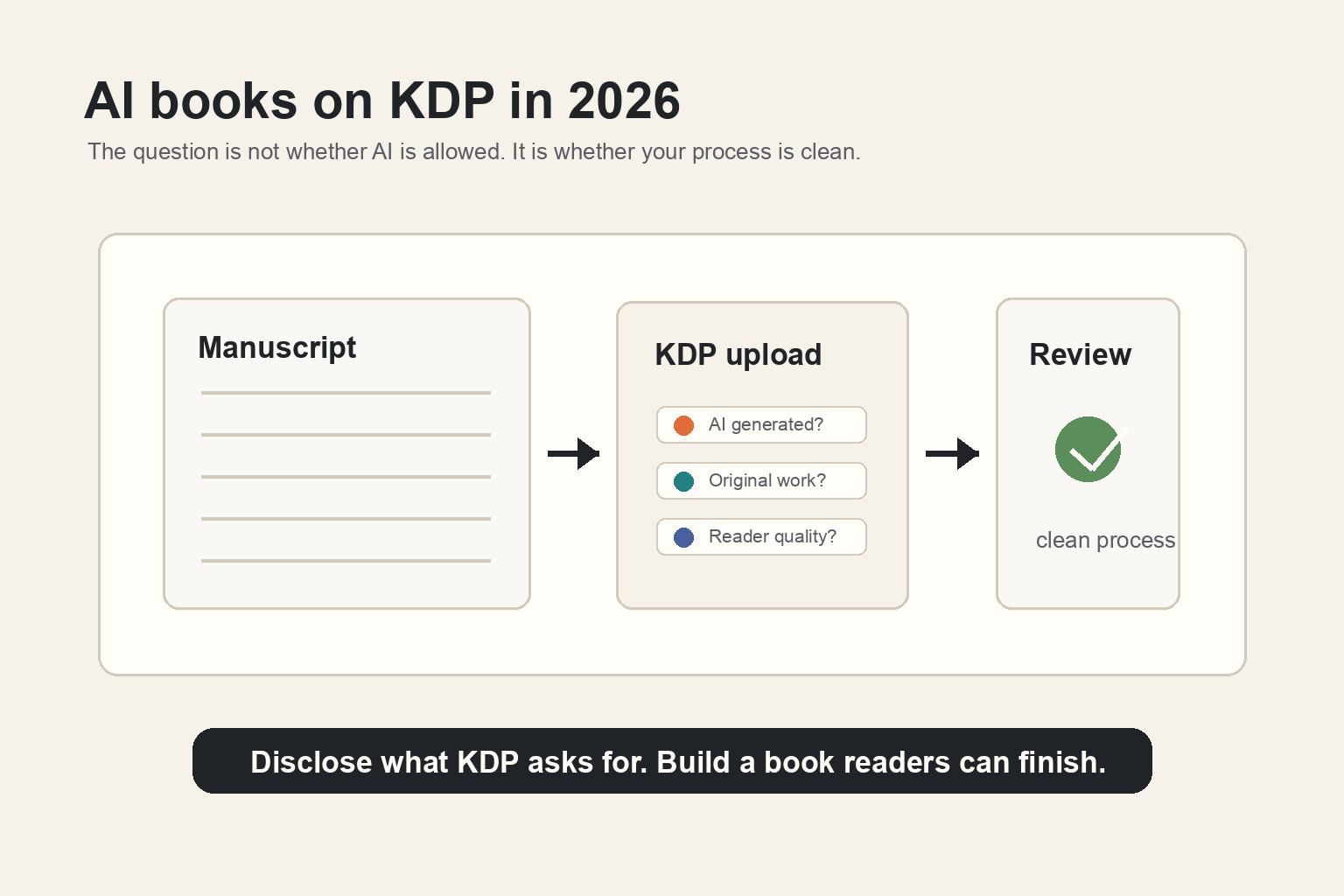
Can you publish a book written by AI on Amazon KDP in 2026? Yes, but that answer is too thin to be useful.
The real question is whether your AI workflow produces a book that is original, coherent, correctly disclosed, and good enough for readers. Amazon is not banning every author who uses AI. Amazon is asking authors to disclose AI-generated content and follow the same content rules that apply to every other book.
That is where most bad advice breaks.
Amazon's own KDP Content Guidelines say authors must inform KDP about AI-generated text, images, or translations when publishing or republishing through KDP. The same page says authors are not required to disclose AI-assisted content.
That distinction matters. It is also where a lot of authors get nervous.
What KDP actually cares about
KDP is not asking whether you used a modern tool somewhere in your process.
It is asking whether AI-generated material appears in the book you are publishing.
If AI generated the manuscript text, cover image, interior images, or translation that appears in the final book, KDP wants that disclosed during upload. If AI helped you brainstorm, outline, edit, research, or check grammar, but the final creative content was created or materially rewritten by you, that falls into a different bucket.
This is not legal advice. It is the practical publishing distinction authors have to understand before they upload.
The dangerous move is not using AI. The dangerous move is treating the KDP checkbox like a reputation problem instead of a compliance step.
If the book contains AI-generated content, disclose it. Then make sure the book itself is worth publishing.
The search trend is really about risk
Authors searching this topic are not only asking, "Will Amazon allow this?"
They are asking:
- Will my book get rejected?
- Will my account get flagged?
- Will readers call it AI slop?
- Do I have to disclose ChatGPT?
- Can I use AI without losing my voice?
- Can I produce faster without publishing junk?
That is why this topic keeps showing up beside searches for AI writing tools. Laterpress has a current roundup of writing tools for fiction authors, and the useful pattern is obvious: authors are not looking for one magic button. They are assembling workflows for planning, drafting, editing, formatting, and publishing.
A tool list is helpful. It does not solve the deeper problem.
The deeper problem is whether your process can carry a book from premise to finished file without losing the plot, the voice, the continuity, or the reader promise.
ChatGPT can help, but it is not a publishing system
ChatGPT, Claude, Gemini, and other general AI tools are useful.
They can brainstorm premises. They can help you outline. They can rewrite awkward sentences. They can summarize research. They can suggest blurbs and metadata drafts.
That does not mean a chat thread is the right place to produce a publishable novel.
Tom's Guide made the same practical point in its piece on where ChatGPT breaks down during novel writing. The issue is not whether a chatbot can start strong. The issue is whether it can hold long-form continuity and tone across a full book.
That is where authors get burned.
Chapter one sounds good. Chapter four forgets the setup. Chapter nine repeats the emotional beat. Chapter fourteen changes the voice. The ending pays off a version of the story that no longer matches the outline.
Then the author has to become the repair crew.
If you want the direct comparison, read StoryForge vs ChatGPT for novel writing. The short version is simple: direct chat is flexible, but a novel needs memory, structure, and downstream validation.
AI-generated is not the same as low quality
A lot of public AI book discourse collapses two different questions into one.
Question one: was AI used?
Question two: is the book any good?
Those are not the same question.
A human can publish a bad book. AI can help create a useful one. AI can also flood a manuscript with generic phrasing, broken continuity, and plot logic that collapses under reader attention.
KDP disclosure does not fix quality.
Disclosing AI-generated content tells the platform what kind of content you are uploading. It does not make the book original. It does not make the prose consistent. It does not make your genre promise work. It does not make readers forgive a sloppy ending.
That is why the better question is not "Can AI write a KDP book?"
The better question is "What workflow keeps the book publishable?"
A safer AI book workflow for KDP authors
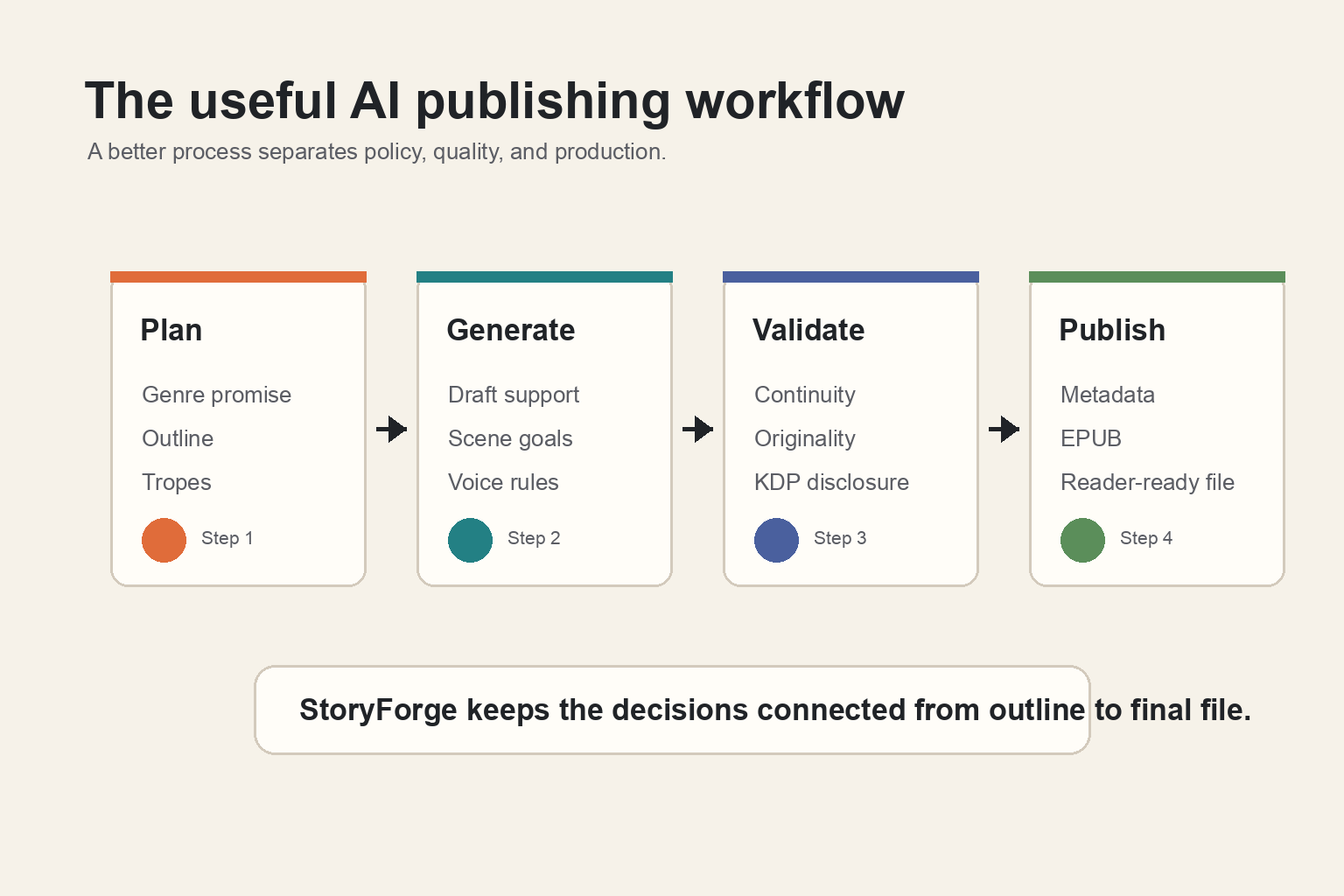
A serious AI-assisted book process has five parts.
1. Start with the reader promise
Before you generate prose, define the book.
Genre. Trope. Heat level. Point of view. Series position. Core cast. Ending shape. Reader expectation.
If you are writing cozy mystery, the clue path matters. If you are writing KU romance, the relationship escalation matters. If you are writing progression fantasy, the power curve matters.
AI can produce fluent pages without understanding why the reader bought the book.
A real outline protects you from that. If planning is the weak point in your process, read why indie authors need a real novel outline.
2. Keep an authorship record
You do not need to turn your writing process into a legal drama.
But you should know what happened.
What did you write? What did AI generate? What did you rewrite? What did AI only help brainstorm? Which images came from AI? Which translation tool did you use?
If you cannot explain your process to yourself, you are going to struggle when the upload form asks about AI-generated content.
A clean process makes disclosure boring.
Boring is good here.
3. Preserve voice before drafting at scale
Most authors worry that AI will sound generic.
They should.
Generic voice is one of the easiest ways for readers to feel that a book was assembled instead of written.
Voice is not just vocabulary. It is sentence length, rhythm, interiority, dialogue pressure, sensory preference, humor, restraint, and how the narrator handles emotion.
If you let a general AI model invent the voice chapter by chapter, the book will drift.
If voice is your main concern, read how to write a novel with AI without losing your voice.
4. Validate continuity before upload
The longer the book, the more expensive drift becomes.
Names change. Timelines break. Side characters repeat discoveries. Magic systems bend. Romantic conflicts reset. A clue is planted after it is needed.
Readers may not know which tool caused the problem. They only know the book feels careless.
That is the part many AI publishing workflows skip.
They generate the draft, then leave the author with a pile of cleanup work.
The better process checks continuity while the book is being built, not only after the final manuscript exists.
5. Treat KDP upload as the final step, not the whole strategy
KDP upload is not the hard part.
The hard part is producing a book that deserves to be uploaded.
That means clean metadata, correct disclosure, a readable EPUB, a coherent manuscript, and a book that delivers the genre promise on the cover.
AI can make this faster. It can also make it easier to publish too soon.
That is the trap.
Where StoryForge fits
StoryForge is built around the part authors actually need help with: turning an idea into a complete, voice-locked, KDP-ready novel without stitching five separate tools together.
The product is not a prompt box. It is a book workflow.
The outline matters. The voice profile matters. The chapter plan matters. The continuity checks matter. The final file matters.
That is the difference between "AI wrote some pages" and "I have a book I can publish."
If you are choosing tools, this is the decision rule:
Do not ask whether the tool can generate text.
Ask whether it can carry decisions forward.
If you define the trope, does it shape the chapters?
If you lock the voice, does it hold in the climax?
If you change the outline, does the draft plan update?
If a series fact appears in book one, does book three remember it?
If the answer is no, the tool may still be useful. It is just not the whole publishing system.
The practical answer
Yes, you can publish a book written with AI on Amazon KDP in 2026.
You still need to disclose AI-generated content when KDP asks for it.
You still need to avoid misleading metadata, copyright problems, duplicate content, and low-effort output.
You still need a book that reads like one author made a series of intentional decisions.
That is the real bar.
AI can help you reach it faster. The wrong workflow can make you miss it faster.
Production note: this article was researched with current search results and official KDP guidance, drafted by Codex from StoryForge marketing guardrails, checked for working source links and no em dashes, and published through StoryForge's signed blog workflow. I used automation because authors searching this topic need a clear, current answer about AI publishing risk and workflow.
If you want the outline, voice, draft, continuity, and KDP-ready file in one connected workflow, start your free trial.
Ready to turn a book idea into a publish-ready manuscript?
Start your free trial