StoryForge Library
AI Book Generators for Fiction: What Actually Matters
AI book generators can draft fast, but fiction authors need more than pages. Learn what matters for voice, continuity, outline, and KDP-ready books.
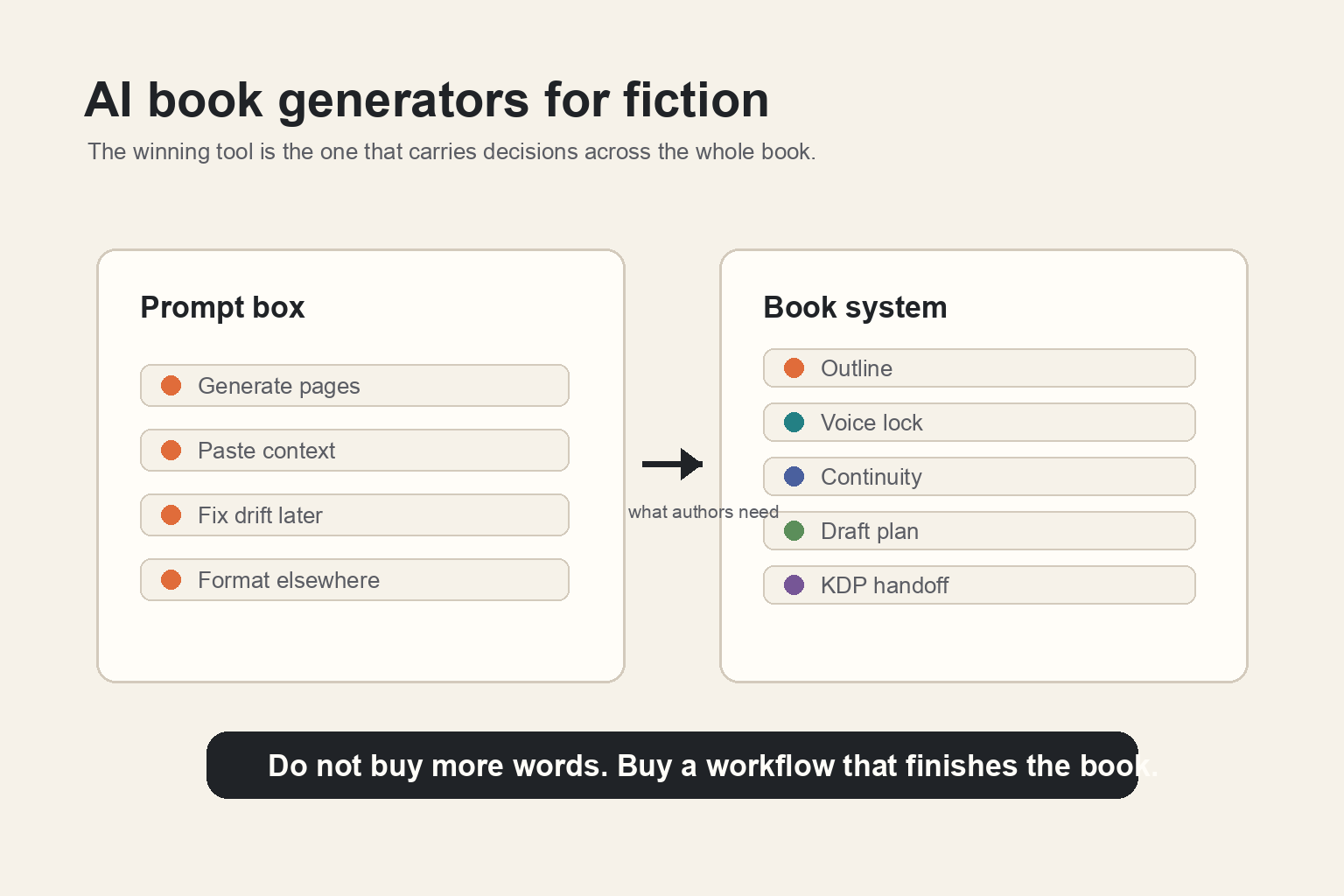
If you are searching for an AI book generator for fiction, you are probably not looking for another tool that can spit out pages. You want a faster path from idea to finished novel without ending up with generic prose, broken continuity, or a manuscript you have to rebuild by hand.
That is the real buying question.
The internet is now full of AI book generators, AI story generators, and AI writing assistants. Laterpress keeps a current guide to AI story generators for fiction writers, and the pattern is obvious: authors are not just asking whether AI can write. They are asking which workflow can help them finish something worth publishing.
The phrase AI book generator hides three different products
When an author types "AI book generator," they may mean one of three things.
They might want a chatbot that helps brainstorm and draft scenes.
They might want a fiction writing assistant that sits beside their manuscript.
They might want a full book workflow that can plan, draft, revise, and prepare a publishable file.
Those are not the same product.
A chatbot can be useful. It is flexible. It can answer almost anything. It can help you test premises, build characters, rewrite a paragraph, or think through a chapter problem.
A writing assistant is more focused. It may understand fiction better than a general chat tool. It may help with prose expansion, scene beats, character notes, or worldbuilding.
A book workflow is different. It has to carry decisions forward. It has to remember what the book promised. It has to preserve voice. It has to know what was established earlier. It has to move the manuscript toward a format you can actually publish.
That last category is where serious indie authors should be looking.
Why one-click book generation usually breaks
One-click generation sounds good until you read the whole draft.
The first chapter can sound fine. The premise can feel strong. The first scene might even make you think the tool solved the hard part.
Then the book starts bending.
A character wants the wrong thing. A romantic conflict resets after it was already resolved. A magic rule changes because the current chapter needed an escape hatch. A side character repeats information they already learned. The voice gets flatter each time the model moves farther away from the original prompt.
That is not a small edit.
That is a structural repair job.
The problem is not that AI cannot produce sentences. The problem is that fiction is not a pile of sentences.
Fiction is dependency management.
The outline affects the chapter plan. The trope affects the midpoint. The point of view affects the prose. The backstory affects the dialogue. The series bible affects book four. The ending affects what has to be planted early.
If your AI book generator treats each chapter like a fresh content request, you become the system holding the book together.
The real test: can it carry decisions forward?
Here is the simplest way to evaluate any AI book generator.
Do not ask whether it can write a chapter.
Ask whether it can carry decisions forward.
If you define the reader promise, does the tool keep writing toward it?
If you choose enemies to lovers, does the relationship arc escalate instead of looping?
If you define a voice, does that voice still hold in chapter eighteen?
If a side character knows a secret in chapter five, does the book remember that in chapter twelve?
If you change the outline, does the rest of the plan adjust?
If the answer is no, the tool may still be useful. It is not a full-book generator. It is a writing helper.
That difference matters if you publish for readers.
Search demand is moving toward complete workflows
The current search results are crowded with tool lists because authors are trying to choose a stack. Laterpress also maintains a 2026 guide to writing tools for fiction authors, and the useful takeaway is not that every author needs the same app. The useful takeaway is that fiction writers are comparing tools by workflow: brainstorming, outlining, drafting, editing, formatting, and publishing.
That is the right frame.
The old question was, "Can AI write?"
The current question is, "Which AI setup can help me finish a book without creating more cleanup than it saves?"
That is where general chat tools start to feel thin.
Tom's Guide made this point in its piece on where ChatGPT breaks down during novel writing. General AI tools can help you start, but long-form fiction exposes memory, continuity, and tone problems fast.
If you want the direct comparison, read StoryForge vs ChatGPT for novel writing.
What fiction authors should actually look for
An AI book generator for fiction needs to pass four tests.
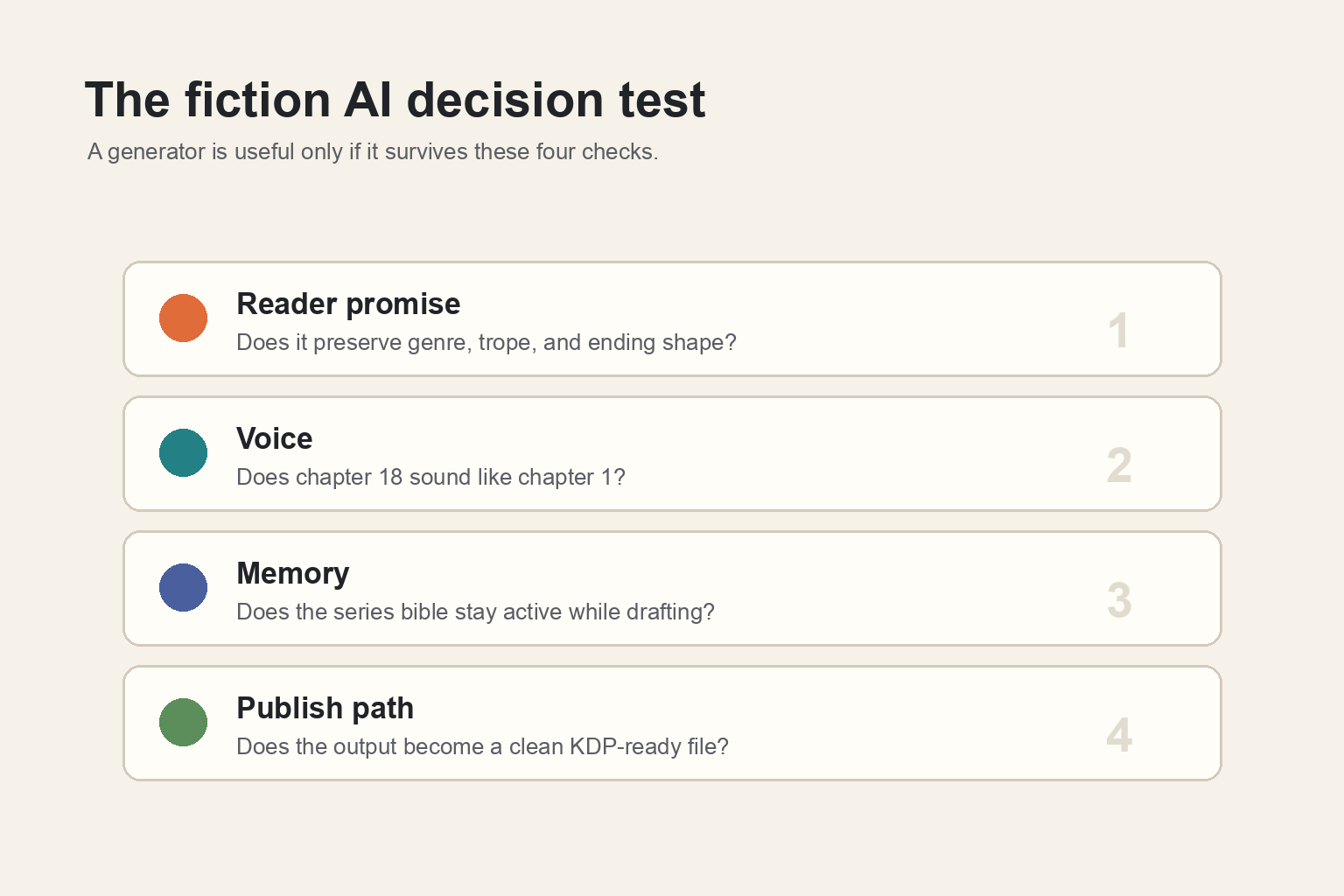
1. Reader promise
The tool should understand the kind of book you are writing before it generates the book.
Genre is not decoration.
A cozy mystery needs fair clues. A KU romance needs relationship escalation. A fantasy novel needs rules that do not collapse. A thriller needs pressure. A LitRPG book needs progression that feels earned.
If the generator asks for a premise and then starts producing chapters, it is probably skipping the work that protects the book.
The outline is not busywork. It is the map that keeps the draft from wandering. If that is the problem you are trying to solve, read why indie authors need a real novel outline.
2. Voice control
Most AI-generated fiction fails because it sounds average.
Not unreadable. Average.
The sentences are smooth. The emotion is obvious. The dialogue is serviceable. The prose explains what the reader should feel instead of making the scene carry it.
A serious fiction tool has to protect voice before scale.
Voice is rhythm, restraint, interiority, humor, sensory bias, sentence pressure, and how a point of view character notices the world. If the tool cannot learn and preserve that, it will keep pulling your book toward the middle of the internet.
If voice is the anxiety point, read how to write a novel with AI without losing your voice.
3. Continuity memory
Novel writing is long enough for small mistakes to become visible.
A character name changes. A location moves. A clue appears too late. A romance beat repeats. A series rule bends because the model forgot the earlier scene.
Readers do not care which tool caused the problem. They only feel the book stop working.
This is why a fiction generator needs a live book memory, not just a long prompt.
Characters, locations, rules, plot promises, open loops, and prior decisions need to stay available while the next chapter is drafted.
4. Publishing path
A book generator that stops at raw text is not really a publishing workflow.
For indie authors, the draft still has to become a clean manuscript. It needs revision. It needs metadata. It needs disclosure decisions if AI-generated content appears in the book. It needs files that make sense for KDP and other retailers.
Amazon's KDP Content Guidelines are a useful reminder that the upload step includes policy and content responsibility. AI does not remove that responsibility. It makes a clean workflow more important.
If you are specifically worried about publishing AI-assisted books on Amazon, read Can You Publish an AI Book on Amazon KDP in 2026?.
Where StoryForge fits
StoryForge is built for the author who wants the whole workflow, not another prompt box.
The point is not to generate a random book-shaped object.
The point is to take a premise, build a real outline, lock the voice, draft against the plan, preserve continuity, and move toward a KDP-ready file.
That matters because indie authors are not playing with AI for novelty. They are trying to ship books without quality collapse.
A tool that gives you ten thousand words fast but costs you weeks in repair did not save you much.
A tool that carries your decisions forward is different.
That is the category StoryForge is trying to own.
The practical answer
The best AI book generator for fiction is not the one that produces the most text from the smallest prompt.
It is the one that helps you finish a coherent book.
Look for outline depth. Look for voice control. Look for continuity memory. Look for revision and publishing support. Look for a workflow that makes the book easier to finish, not just easier to start.
If the product cannot explain how it keeps the book together, assume you will be doing that job yourself.
Production note: this article was researched from current search results and source-backed AI writing coverage, drafted by Codex from StoryForge marketing guardrails, checked for working source links and no em dashes, and published through StoryForge's signed blog workflow. I used automation because authors searching this topic need a clear way to separate AI generator hype from a publishable fiction workflow.
If you want an AI workflow that carries outline, voice, continuity, drafting, and publishing forward together, start your free trial.
Ready to turn a book idea into a publish-ready manuscript?
Start your free trial